Credit, Loan to Value and Debt to income are a few of the key factors in your qualification for a mortgage. Read on to learn more about each key factor.
Details About Credit Risk
About Credit Scores
Credit Scores are provided to lenders by the three major credit reporting agencies: Equifax, Experian and Trans Union.
Credit Scores provide the best guide to future risk based solely on credit report data. The higher the score, the lower the risk. But no score says whether a specific individual will be a “good” or “bad” customer.
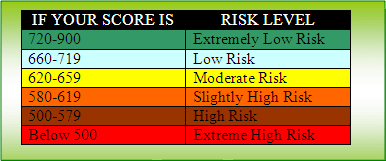
Credit Score Risk Table
Tips for Raising Your Score:
-Pay your bills on time.
-If you have missed payments, get current and stay current.
-Be aware that paying off a collection account will not remove it from your credit report.
-If you are having trouble making ends meet, contact your creditors or see a legitimate credit counselor.
-Keep balances low on credit cards and other “revolving credit.”
-Pay off debt rather than moving it around.
-Don’t close unused credit cards as a short-term strategy to raise your score.
-Don’t open a number of new credit cards that you don’t need, just to increase your available credit.
-If you have been managing credit for a short time, don’t open a lot of new accounts too rapidly.
-Re-establish your credit history if you have had problems.
-Apply for and open new credit accounts only as needed.
-Have credit cards but manage them responsibly.
-Note that closing an account doesn’t make it go away.
A credit score takes into consideration all these categories of information.
1) Past payment history
2) Amount of credit owing
3) Length of time credit established
4) Search for and acquisition of new credit
5) Types of credit established Your credit score only looks at information in your credit report. However, lenders look at many things when making a credit decision including your income, equity, how long you have worked at your present job and the kind of credit you are requesting.
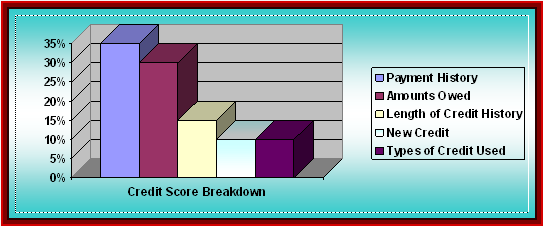
Credit Score Breakdown
Your score considers both positive and negative information in your credit report. Late payments will lower your score, but establishing or re-establishing a good track record of making payments on time will raise your score.
Who do I contact to to dispute items on my credit report?
Equifax
PO Box 740241
Atlanta GA 30374
800-685-1111
www.equifax.com
Transunion
2 Baldwin Place
PO Box 2000
Chester, PA 19022
800-888-4213
www.transunion.com
Experian
701 Experian Parkway
P.O. Box 2002
Allen, TX 75013
888-397-3742
www.experian.com
Debt To Income Ratio
The Debt to Income Ratio is calculated by dividing the total monthly payment by the total monthly income. Example:
If your family’s household income (for all borrowers) is $10,000 per month gross before taxes are subtracted and your total monthly expenses including credit cards, auto loans, mortgage loans, home equity loans and any other installment or revolving debt total 3,000 per month then your Debt to income ratio would be 30%.
Debt To Income Risk Analysis Table
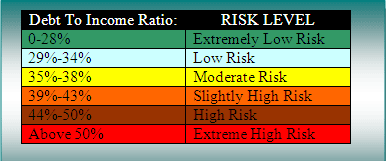
Debt To Income (DTI) Ratio is derived by dividing total of monthly payments by gross monthly income. The lower your Debt To Income Ratio the lower your risk is to the lender.
Loan to Value Ratio
What is Loan To Value aka LTV? It’s the loan amount divided by the appraised value of your home. Loan to value demonstrates the percentage of the home that is leveraged. The Loan to Value is important for us to evaluate the risk the overall risk. The greater the Loan To Value percentage the greater the risk to the lender.
Loan To Value Ratio Table
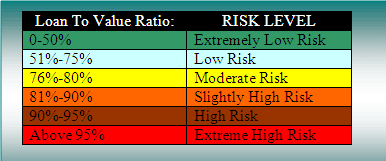
Loan To Value and Equity
Loan To Value (LTV) Ratio is derived by taking the new loan amount and dividing it by the homes appraised value. The lower the Loan To Value the lower the risk to the lender.
Equity is the determined by subtracting your homes value from the loans that have been borrowed against. The greater the equity the lower the risk. Example:
If your home appraises for $100,000 and you want to borrow $75,000 the loan to value ratio is 75%.
In the same scenario the equity would be determined by subtracting the loan amount of 75,000 from the appraised value of $100,000 which would yield $25,000 in equity.